
A pothole by the front entrance has a way of becoming everyone’s problem. Tenants complain, delivery drivers swerve around it, and eventually somebody catches a heel or a tire on the edge. If you manage commercial property in Columbia, you’ve probably watched a soft spot open into a crater after a few freeze-thaw swings in February.
Most of these problems can be fixed without tearing out the whole lot. The trick is to catch them early and match the repair to what’s actually wrong underneath. This guide covers why asphalt fails, which patching methods hold up, how to prioritize repairs on a tight budget, how to read a repair proposal, and what to ask a paving contractor before you sign anything.
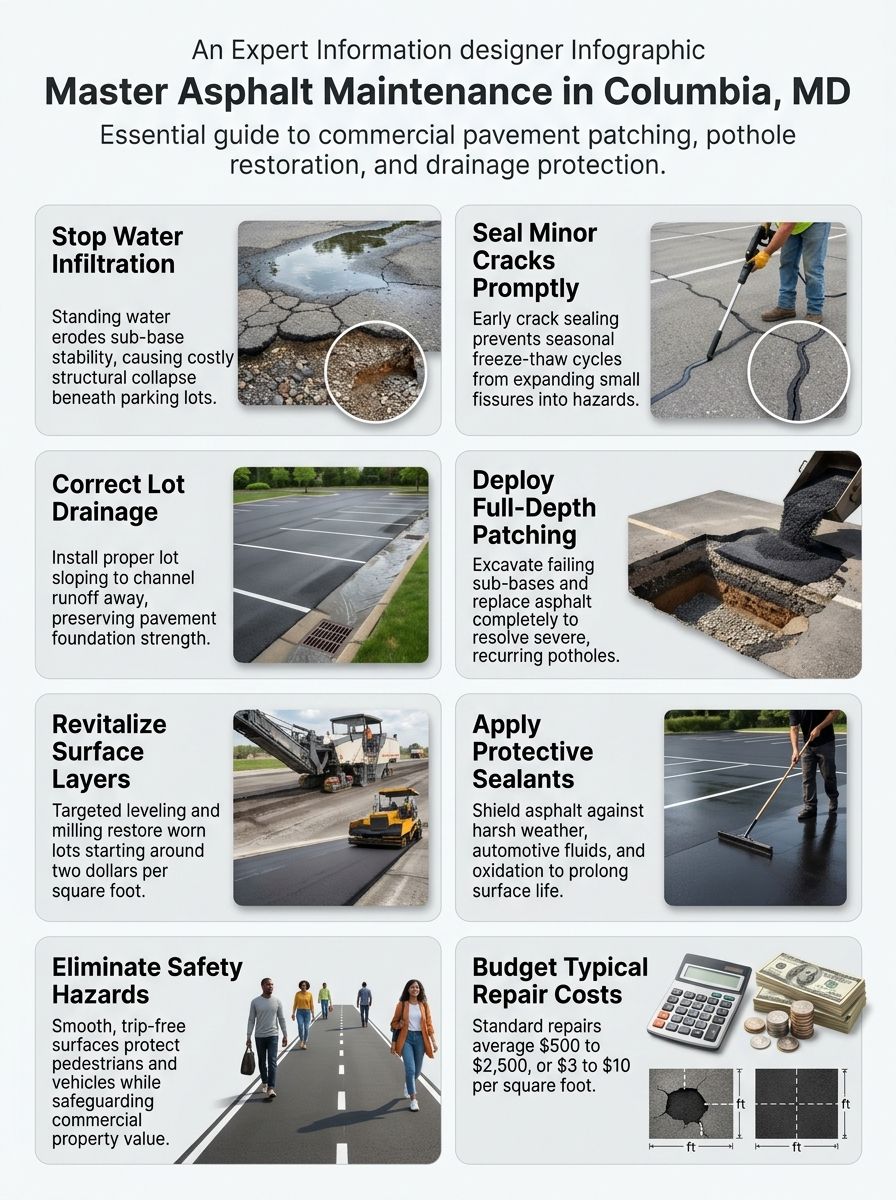
Asphalt is flexible and slightly porous. It depends on a firm, dry base underneath to carry the load. Nearly every failure on a commercial lot comes back to water, weather, or weight, and usually all three working together.
Every open crack lets water reach the aggregate base below the asphalt. That moisture softens the base and washes out the fine particles that hold it together. Once the base loses strength, the pavement flexes each time a vehicle rolls over it. Flexing creates more cracks, which let in more water, and the cycle speeds up the longer you leave it alone.
Winters in Howard County regularly swing above and below freezing. Water trapped in cracks and in the base freezes, expands, and pushes the pavement apart. When it thaws, it leaves voids behind. Traffic then breaks the weakened surface, and that’s how a lot that looked fine in November ends up with a crop of potholes by March.
Trash haulers, delivery trucks, and the constant stop-and-turn traffic at entrances concentrate stress on small areas. Drive lanes, loading zones, and dumpster approaches usually fail first. A single loaded truck puts far more strain on pavement than a passenger car, so a lot that sees regular truck traffic will wear out faster in those areas.
Sun and air slowly dry out the asphalt binder, which is the glue holding the stone together. Older pavement turns gray, gets brittle, and cracks more easily. A lot that has gone years without crack filling or sealcoating usually needs more patching, more often.
Some damage is obvious, while other problems go unnoticed until they become expensive. On your regular property walks, look for:
Take dated photos and note the location of anything you find. That record helps you see whether problems are spreading, makes it easier to prioritize, and gives your contractor useful history when they assess the lot. Catching damage at the crack or soft-spot stage means asphalt repair stays smaller and cheaper.
Few property managers can fix everything at once. A simple ranking helps you spend money where it reduces risk the most.
Waiting has a cost, though. A pothole keeps growing as traffic breaks down its edges and water keeps reaching the base. Quick parking lot pothole repair keeps each patch small. Holding off usually means a bigger area to cut out and more base material to replace, and the lot looks worse to tenants and prospects in the meantime.
“Patching” covers several techniques, and the right one depends on how deep the damage goes. If you’ve been searching for asphalt patching contractors in Columbia, MD, these are the methods you’ll likely see in proposals. The descriptions below reflect general industry practice.
Throw-and-roll means placing patch material, usually cold mix, straight into the hole and compacting it with truck tires. It’s fast and handy when hot-mix asphalt isn’t available, which matters in winter, since many asphalt plants in colder regions shut down for the season. Think of it as the duct tape of pavement repair: great in a pinch, but not something you’d want to rely on forever.
The Federal Highway Administration’s long-term pavement study found that, at highway test sites, throw-and-roll with high-quality materials performed about as well as the more labor-intensive semi-permanent method. The researchers also found that material quality mattered more than the procedure, and that cheap cold mix tends to be more costly over time due to repeated repairs. On a commercial lot with regular truck traffic, it still makes sense to treat cold patch as a way to make a hole safe until a permanent hot-mix repair can go in.
When the surface is damaged, but the base below is still solid, a partial-depth patch is often the right call. In a typical saw-cut patch, the crew cuts the damaged area into a square or rectangle with straight, vertical edges. FHWA patching guidance recommends extending that outline at least a foot past the visible damage so the patch meets sound pavement.
From there, the crew removes the broken asphalt, then cleans and dries the hole. A tack coat on the vertical edges helps the new asphalt bond. Crews then place and compact hot-mix asphalt in lifts of no more than about 3 inches, using a plate compactor for small patches or a roller for larger ones. The finished patch sits slightly above the surrounding pavement to allow for some settling under traffic. Once it cools, sealing the edges helps keep water out of the seam, a common weak point.
If you’re seeing alligator cracking or pavement that feels spongy underfoot, the problem lives in the base. Full-depth patching removes the asphalt and the failed base material beneath it, then rebuilds the base with fresh aggregate, compacts it, and finishes with new hot-mix asphalt in compacted layers. It takes more time and material than a surface patch, but it fixes the cause rather than covering it. For commercial pothole repair in drive lanes, loading areas, and dumpster approaches, full-depth repairs are usually the long-term solution.
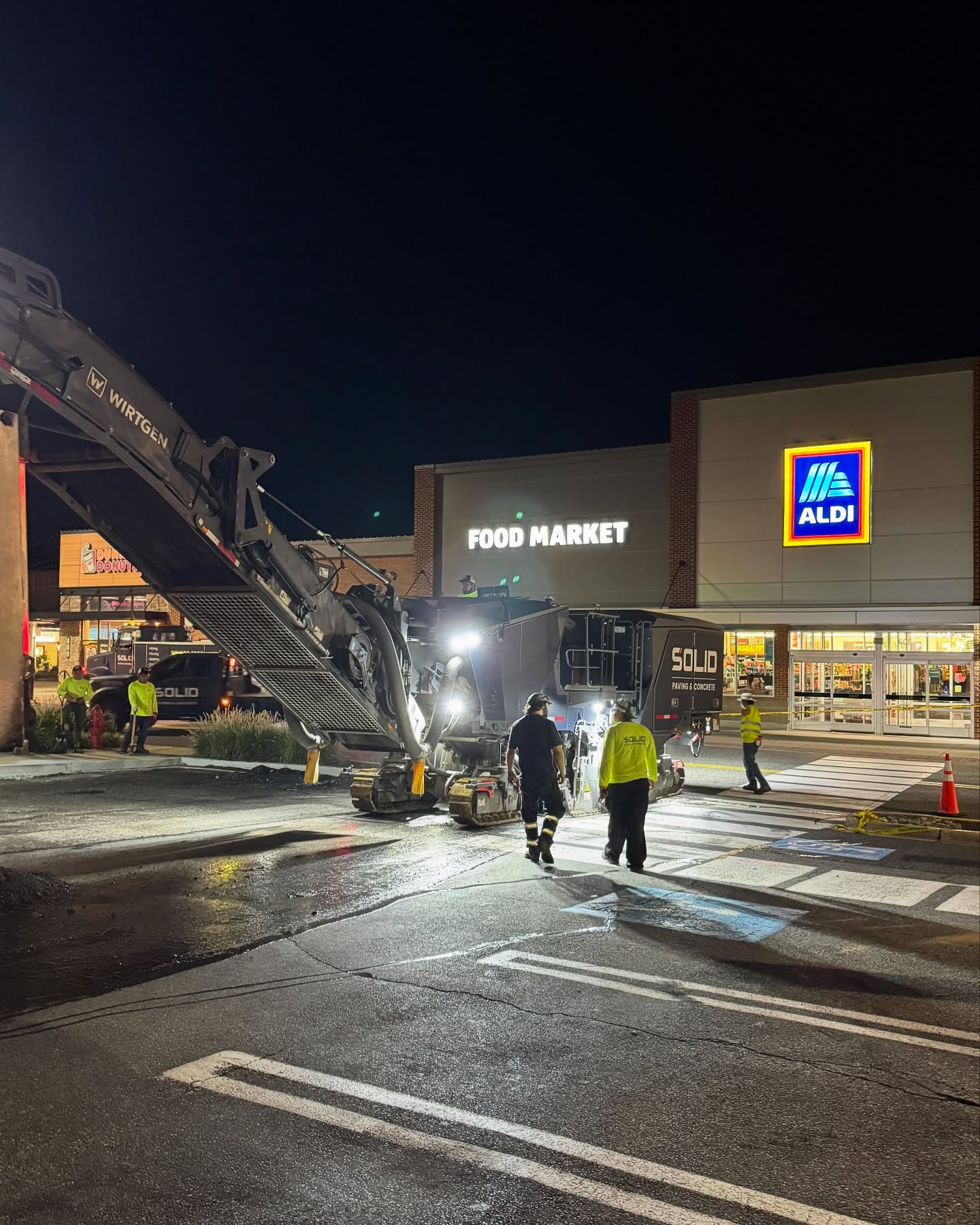
When damage affects large sections of the lot, patching one hole at a time no longer makes financial sense. Milling grinds off the worn top layer of asphalt, and a new layer goes down in its place. It’s a middle ground between scattered patches and full replacement, leaving a uniform surface that’s easier to maintain. Solid Paving & Concrete owns and operates its own milling, paving, and compaction equipment, which helps with scheduling and quality control on larger jobs.
Patching takes care of the damage you can see, while crack filling and sealcoating slow down what comes next. Crack filler keeps water out of cracks that haven’t failed yet, and sealcoat protects the surface from UV, moisture, and oil drips.
Timing matters here. According to the Pavement Coatings Technology Council, new hot-mix asphalt usually needs 30 to 90 days to cure before sealcoating, and cold-mix pavement needs at least 90 days. Fresh asphalt needs time to harden, so sealing too soon can affect how well the sealcoat performs. Your contractor may adjust the timeline based on weather and the mix used.
A site assessment always beats a guess, but this quick reference helps you walk into that conversation knowing your options.
|
What You’re Seeing |
Likely Fix |
|---|---|
|
Hairline to moderate cracks, no soft spots |
Crack filling and sealcoating |
|
Isolated potholes with solid pavement around them |
Saw-cut hot-mix patch |
|
Alligator cracking or soft, spongy areas |
Full-depth patching |
|
The same spot patched two or more times |
Full-depth patching and a drainage check |
|
Widespread cracking, wear, and old patches across large sections |
Mill and overlay |
|
Base failure across most of the lot or major drainage problems |
Full reconstruction |
If a large portion of your lot needs patching, ask your contractor to price a mill-and-overlay alongside the patching option. Seeing both numbers side by side makes the long-term tradeoff much easier to judge.
A well-built patch can still fail if water keeps pooling in the same spot. Ponding usually points to poor slope, a settled area, or a clogged or damaged storm drain. Broken curbs and gutters can also direct water beneath the pavement edge rather than toward the drain.
Drainage is the unglamorous part of the job, but it usually decides whether a patch holds up. Walk the lot during or right after a heavy rain and note where water collects. Correcting slope, repairing curb and gutter, or rebuilding the pavement around a drain inlet adds to the project, but it can save you from redoing the same patch next spring. Good parking lot repair starts with getting water off the pavement and away from the base.
Two proposals that both say “patch 1,000 square feet” can be as different as a drive-thru burger and a steakhouse cut. Here’s what a clear proposal should include so you can compare bids fairly:
If one bid comes in far lower than the others, look closely at depth and base work first. That’s often where bids differ the most, and it’s the part you can’t see once the job is done.
Every property is a little different, but most patching projects follow a similar path.
Weather plays a big role in asphalt patch repair. Hot-mix work needs dry conditions and moderate temperatures, which is why spring through early fall is the main paving season in Maryland. If you find damage in winter, a temporary fix can hold until conditions allow a permanent repair.
It depends on what’s going on under the surface, and nobody can give you a real number without seeing the lot. These are the factors that drive cost on pavement repair in Columbia, MD projects:
The biggest money-saver is bundling. Getting a crew and equipment to your site is a real expense, so one planned project usually costs less than a string of emergency calls. When you request a proposal, it’s also worth asking about seasonal specials.
Patches that fail by next winter often trace back to low-quality materials, rushed prep, thin asphalt, or skipped base work. These questions help you find a contractor who won’t cut those corners.
Solid Paving & Concrete is a commercial paving contractor based in Annapolis, serving Columbia and communities across Maryland and Virginia. The team brings more than 15 years of industry experience to projects ranging from a handful of patches to full commercial asphalt repair and milling work. The company is an active member of the Community Associations Institute and the Property Management Association. Those memberships reflect the community association and property management clients it serves.
A dedicated sales team stays involved from scope development through project completion. Solid Paving & Concrete also offers 24-hour emergency service. If you’re dealing with an urgent problem, call 301-500-0309 directly for details instead of using the online form.
Potholes start small and almost never stay that way. Match the repair to the depth of the damage, fix the drainage that caused it, and protect the lot with crack filling and sealcoating once new patches have cured. That approach usually costs less over time than patching the same holes every spring.
Searching for pothole repair in Columbia, MD? Call Solid Paving & Concrete or request a free proposal through the website.
As soon as you notice a hole, loose asphalt, or water sitting in the same spot after rain. Make holes in walkways and entrances safe right away, even if that means a temporary patch. For planned permanent repairs, spring through early fall offers the best conditions for hot-mix work.
Yes, usually with cold mix for temporary or emergency repairs. Cold patch can make a dangerous hole safe during the colder months. A permanent hot-mix repair can follow once temperatures rise and asphalt plants are back in full production.
It depends on the method, the materials, and the condition of the base. Federal research on highway patches found that material quality had a bigger effect on patch life than the repair method. On commercial lots, the standard permanent repair is a hot-mix patch over a sound base, with tack coat, solid compaction, and sealed edges. Full-depth patches hold up best where the base has failed or truck traffic is heavy.
Usually because nobody fixed the underlying cause. Common culprits are a failed base under the patch, water ponding nearby, or a patch with poorly sealed edges that lets water into the seam. A repeat pothole is a strong sign the area needs full-depth repair and a drainage check.
Crack filling seals individual cracks so water can’t reach the base. Patching involves removing and replacing pavement that has already broken down. Think of crack filling as prevention and patching as the fix once damage is done.
Usually not all at once. Contractors typically phase commercial patching projects, so sections stay open. Your contractor should share a schedule and traffic plan in advance so you can give tenants a heads-up.
Business Name: Solid Paving & Concrete
Address: 2901 Riva Trace Pkwy #103, Annapolis, MD 21401
Phone: 301-500-0309
Business Hours:
Mon - Fri: 08:00 AM to 05:00 PM
Sat-Sun: Closed
24 Hour Emergency Service Available
Ask us about our seasonal specials
1 year workmanship warranty